No Safety Issues with 1,200m Runway at Ulleung Airport
May 29, 2025
SUM Air Co., Ltd. (CEO Yongduck Choi) announced on the 27th that, as part of preparations for launching service to Ulleung Airport, it visited Yoron Airport on Yoron Island, north of Okinawa, Japan—an airport with a 1,200m runway similar to Ulleung Airport—together with industry stakeholders, and confirmed that there are no issues with safe ATR72-600 operations on a 1,200m runway.
That day, the group took off smoothly from Kagoshima Airport aboard an ATR72-600 operated by JAC (a JAL subsidiary), the same aircraft type SUM Air is introducing. Contrary to expectations that a propeller aircraft would be noisy, they were surprised to find it was actually quieter. After a flight of just over an hour, the aircraft landed safely at its destination, Yoron Airport. The 1,200m runway felt long—by the time the aircraft exited the runway to head to the ramp area, as much as half of the runway still remained ahead.
Following the recent Muan Airport disaster, controversy has arisen over the safety of Ulleung Airport’s 1,200m runway.
The ATR72-600 that SUM Air Co., Ltd. plans to introduce can operate as a Code 2C aircraft when applying the Multi-MTOW (Maximum Takeoff Weight) certified by the European Union Aviation Safety Agency (EASA). In this case, the takeoff distance is 1,031m and the landing distance is 660m, posing no problem whatsoever for safe takeoffs and landings on a 1,200m runway.
A JAC official said, “The ATR72-600 is an aircraft well suited to island regions with strong winds. We operate it without major problems in takeoffs and landings even in typhoon-strength winds.”
In fact, the ATR72-600 has a direct crosswind limit of 35kts, 5kts higher than the 30kts limit of the B737, the main aircraft type of existing airlines, making it a safer aircraft even in the strong winds characteristic of Ulleungdo.
Asked about airport facilities suited to islands with many rainy and foggy days, a Yoron Airport representative said, “For safer takeoffs and landings, the best option would be to install a precision instrument flight system at the airport rather than relying on visual flight.”
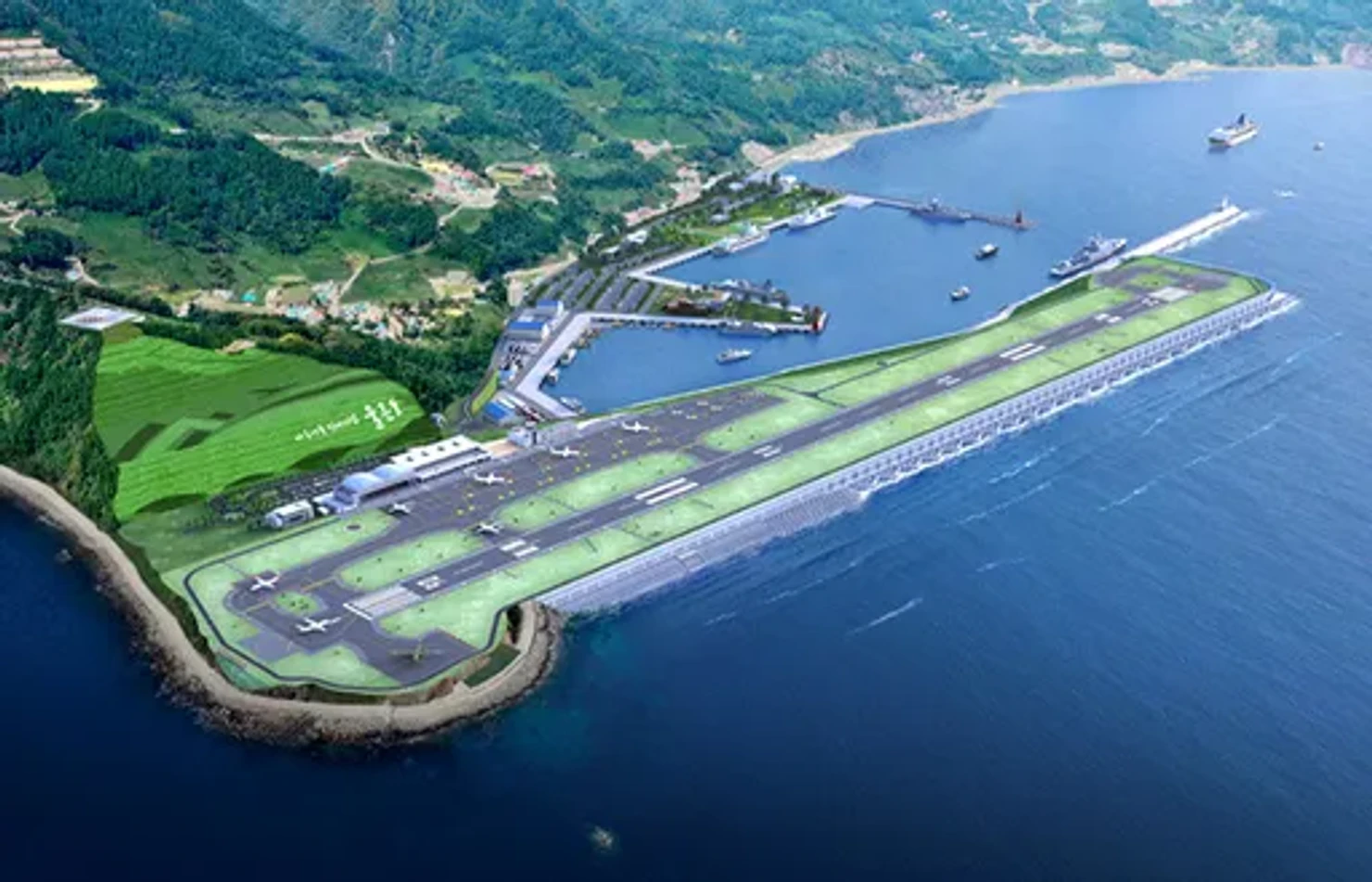
Following the amendment of the Enforcement Decree of the Aviation Business Act (June 10, 2024), which raised the seat limit for small air transport businesses to 80, Ulleung Airport is currently being built as a 3C visual flight airport (3C VFR airport) instead of the originally planned 2C instrument flight airport (2C IFR airport).
However, if it is operated as a visual flight airport, concerns are being raised about the effectiveness of airport operations due to flight safety and higher cancellation rates, given the frequent weather changes typical of island regions. There is growing support for the argument that Ulleung Airport, which experiences relatively frequent adverse weather, must be equipped with an Instrument Landing System (ILS) to ensure safe operations and lower cancellation rates. In fact, according to a technical proposal by Daelim E&C, the current contractor for Ulleung Airport, operating Ulleung Airport as an instrument airport would greatly improve flight safety and reduce the cancellation rate from 26% to 8.7%.
Ulleung Airport will become the design standard for small airports to be built in the future, including Heuksan Airport and Baengnyeong Airport that will follow it. It is therefore time to once again seriously discuss building it as a 2C instrument flight airport, which would achieve both improved safety and lower cancellation rates without unnecessary fiscal spending or extended construction periods.
* Attachment: Construction Direction for Improving Safety and Reducing Cancellation Rates at Ulleung Airport (1 copy)
(Attachment)
Construction Direction for Improving Safety and Reducing Cancellation Rates at Ulleung Airport
1. History of Design Changes at Ulleung Airport
1) The ‘Airport Construction Master Plan (2013)’ designated the runway operating category as 2C VFR (visual flight airport), based on 50-seat aircraft such as the ATR-42 and Q-400 under the registration criteria for small air transport businesses at the time
* 2C VFR: Runway (length 1,100m X width 30m), runway strip (length 60m X width 80m)
2) In 2021, the runway operating category was changed to 2C IFR (instrument flight airport) in consideration of operational safety and cancellation rates
* 2C IFR: Runway (length 1,200m X width 30m), runway strip width (80 → 140m)
* Cancellation rate (Daelim Industrial, Ulleung Airport technical proposal): Visual flight airport (2C VFR) 26%, instrument flight airport (2C IFR) 8.7%
3) In 2024, in consideration of the amendment of the Enforcement Decree of the Aviation Business Act and the aircraft supply situation of small air transport businesses, a further change of the runway operating category to 3C VFR is underway to accommodate the 80-seat-class ATR-72
* Design change: Airport category adjusted (2C→3C), runway strip width expanded (140 → 150m)
* Amendment of the Enforcement Decree of the Aviation Business Act (improved registration criteria for small air transport businesses): Seat limit raised from 50 to 80 seats
2. Need for an Instrument Landing System (ILS) at Ulleung Airport
If Ulleung Airport is operated under visual flight conditions according to the current construction direction, flights will only be possible when visual flight rules (VFR) conditions—visibility of 5km and a ceiling of 450m—are met. According to the 2013 Ulleung Airport preliminary feasibility study report (p. 105), the cancellation rate is reported at 18.1%; since this result was based on the FAA ceiling standard of 300m, the actual rate is expected to be higher. In fact, according to the ‘Ulleung Airport Technical Proposal’ by Daelim Industrial, the current contractor for Ulleung Airport, the cancellation rate when operated as a visual flight airport reaches 26%, exactly matching the 10-year average cancellation rate of passenger ships (26%). By contrast, the rate when operated as an instrument flight airport is reported at 7.8%, a very large difference.
If Ulleung Airport operates as a visual flight airport (3C VFR airport) as currently planned, high cancellation rates and frequent irregular operations are expected to significantly restrict the mobility rights of not only Ulleung residents but also all citizens wishing to visit Ulleungdo, undermine safety, and reduce load factors and operating rates. This could turn it into a loss-making airport and raise fundamental questions about the justification for building and operating the airport. Therefore, it is essential that Ulleung Airport be built as an IFR airport capable of precision instrument approaches.
3. Issues with Installing an Instrument Landing System (ILS) at Ulleung Airport
Ulleung Airport is currently being built as a 3C VFR airport. Changing it to a 3C IFR airport would involve the following issues.
1) Expanding the runway strip width
For Ulleung Airport to become a 3C IFR airport capable of ILS, the runway strip width must be expanded to 280m. However, given Ulleungdo’s coastal topography, this is expected to require astronomical additional funding and a lengthy construction period, and since it would involve reclaiming a steeply sloping seabed, it is unclear whether it is even technically feasible.
2) Questions of effectiveness
Even if Ulleung Airport were built as a 3C IFR airport by overcoming technical difficulties and investing enormous funds and a long construction period, Code 3C aircraft could not operate with the current 1,200m runway length. Raising the airport category from 2C to 3C would therefore yield almost no practical benefit, because the runway length exceeds the 800m–1,199m minimum takeoff distance range for Code 2C aircraft by only 1m. Thus, even with an upgrade to 3C, the restriction on aircraft types that can operate remains, and moreover, the limitation of VFR-only takeoffs and landings makes it even more vulnerable than a 2C IFR airport in terms of safety and cancellation rates. Because of these problems, building Ulleung Airport as a 3C VFR airport with an enormous budget and time cannot be considered adequately justified in terms of its effectiveness.
4. Solutions
The role of an airport is to function as key infrastructure for transporting people and goods while contributing to the economy and people’s lives. In particular, island airports recently under discussion, such as those on Ulleungdo, Heuksando, and Baengnyeongdo, are expected to serve as a foothold for balanced regional development. Ulleung Airport, currently under construction as the first new small airport in an island region, is expected to meet aviation demand not only for Ulleung-gun but also for the Daegu–Gyeongbuk region and make a major contribution to revitalizing the regional economy. Nevertheless, changing it from an instrument airport to a visual airport on the grounds of Ulleung’s regional characteristics may fail to help revitalize the Ulleung economy due to high cancellation rates and frequent irregular operations, and could even give rise to arguments that the airport is useless. Therefore, guaranteeing stable operations as an instrument airport (IFR airport) is essential to revitalizing the regional economy. To this end, solutions to the issues raised above are as follows.
1) Applying Multiple MTOW (Maximum Takeoff Weight)
The ATR72-600, classified as Code 3C, can lower its MTOW to 22 tons by applying WV (Weight Variant)-10 under Multiple MTOW. In this case, the minimum takeoff distance becomes 1,031m, and the aircraft is classified as Code 2C. It can therefore take off and land safely on a 1,200m runway. Accordingly, if this is applied, there is no problem at all in building Ulleung Airport as a 2C instrument airport (2C IFR airport), and since a runway strip width of 140m—10m narrower—would suffice, the airport could be built without additional funding or construction delays. Multiple MTOW is a practice applied by all existing airlines, including Korean Air.
2) Installing Displaced Thresholds
If the 60m runway strip at each end of the runway is constructed as a displaced threshold, the Takeoff Run Available (TORA) increases from 1,200m to 1,320m, effectively extending the runway length. The Landing Distance Available (LDA) also increases from 1,200m to 1,260m, improving landing safety and reducing cancellation rates.
3) Runway Surface Grooving
Due to its regional characteristics, Ulleung Airport is in an area with heavy rain and snowfall. Over the past 10 years, Ulleungdo has averaged a total of 201.2 days of rain or snow per year, roughly two-thirds of the year. The problem is that braking performance is limited when the runway is wet or slippery, which lengthens landing distances and can lead to cancellations. To mitigate this, grooving the runway surface improves braking performance by one level, resulting in safer and more stable flight operations.
In conclusion, Ulleung Airport should be built as a 2C IFR airport by applying the solutions presented above. In this way, it can be built as an airport consistent with the raised passenger limit for small air transport businesses, without enormous budget expenditure for expanding airport facilities or lengthy construction delays. This would also firmly establish an air corridor for sustainable access to Ulleungdo and the promotion of cultural tourism, and contribute significantly to the government’s aviation policy goals of revitalizing regional airports, developing connected regional economies, and improving local residents’ right to air transportation. It is expected to become a cornerstone for opening an era of popularized air travel.